
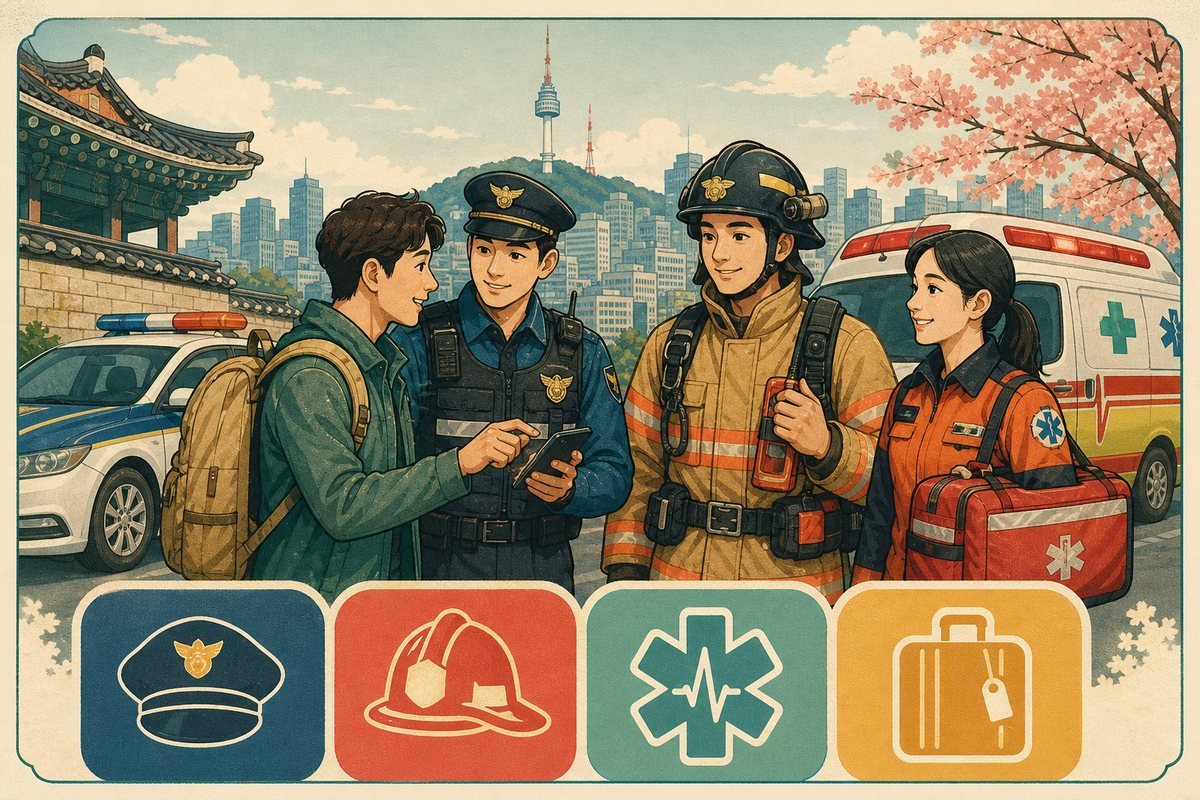
If something goes wrong in Korea, you do not need to search for a local police station or hospital before asking for help. A small set of nationwide numbers connects you to police, fire, rescue, medical emergencies, tourist assistance, and immigration information.
Save these numbers before your trip: 112 for police, 119 for fire or medical emergencies, 1330 for the Korea Travel Helpline, and 1345 for immigration questions.
Emergency numbers at a glance
- 112 — Police: crime in progress, threats, assault, theft, stalking, or an immediate safety concern.
- 119 — Fire, rescue, and medical emergencies: fire, serious injury, sudden illness, ambulance, or rescue.
- 1330 — Korea Travel Helpline: travel information and assistance for international visitors.
- 1345 — Immigration Contact Center: visas, entry status, residence, and immigration procedures.
- 182 — Police information and lost-property guidance: useful for non-emergency police questions.
- 1339 — Infectious-disease information: guidance related to infectious-disease concerns.
For an immediate danger, call 112 or 119 first. The travel helpline is useful, but it is not a replacement for emergency dispatch.
When to call 112
Call 112 when you need the police quickly. Examples include a violent incident, an active threat, burglary, sexual assault, a suspected scam happening in front of you, or a situation where you are being followed and do not feel safe.
Start with your location and the type of danger. If you do not know the street address, name the nearest subway station, exit number, hotel, store, landmark, or intersection. Show a map pin to someone nearby if speaking is difficult.
For a lost wallet, phone, or bag with no immediate danger, first ask the business, taxi company, subway station office, or local police station. Korea also operates the LOST112 system for registered lost property. A non-urgent loss generally does not require an emergency dispatch.
When to call 119
Call 119 for fire, rescue, or a medical emergency. This includes severe breathing difficulty, loss of consciousness, major bleeding, a serious traffic collision, suspected stroke or heart attack, or any situation where moving the person could make an injury worse.
Tell the dispatcher what happened, where you are, how many people need help, and whether the person is conscious and breathing. Follow the dispatcher’s instructions. Do not give food, drink, or medication to an unconscious person.
If the situation is urgent but you are unsure whether an ambulance is needed, explain the symptoms clearly and let the emergency service guide you. This article provides general travel information and is not a substitute for professional medical advice.
Language help during an emergency
Do not delay an emergency call because your Korean is limited. Speak slowly, use short English sentences, and repeat the location first. The Korean National Police Agency operates foreign-language interpretation support for 112, but availability and connection time can vary by situation.
Useful information to prepare on your phone includes your hotel name in Korean, the full Korean address, a screenshot of your map location, your passport information page, travel-insurance contact details, allergies, regular medication, and an emergency contact.
How to call from a foreign phone
When you are physically in Korea and connected to a Korean mobile network, dial the short number directly: 112, 119, 1330, or 1345. You normally do not add Korea’s country code to a domestic emergency call.
If your phone has no service, ask a hotel desk, restaurant, convenience store, station employee, or nearby person to place the call. Public safety comes first; use clear gestures and show the number on your screen.
Using the 1330 Korea Travel Helpline
The 1330 Korea Travel Helpline assists international visitors with travel information and practical problems. According to the Korea Tourism Organization, multilingual assistance is available in several languages. Language availability may change, so confirm the current service details on the official website.
Use 1330 for travel guidance, interpretation support related to tourism, or help identifying the correct organization. Use 112 or 119 instead when a person is in danger or needs emergency dispatch.
Embassies, insurance, and hospitals
After immediate danger has passed, contact your embassy or consulate if a passport was stolen, you were arrested, or you need consular assistance. An embassy does not replace Korean emergency services and generally cannot pay medical bills or cancel local legal procedures.
Contact your travel insurer as soon as practical. Ask what documents are required, such as a medical certificate, itemized hospital bill, police report, prescription, or proof of delay. Keep digital copies of every receipt and report.
What to say first
- “Emergency. I need police.”
- “Emergency. I need an ambulance.”
- “My location is…” followed by the address or landmark.
- “The person is conscious / unconscious.”
- “There is a fire / traffic accident / serious injury.”
- “I speak English. Please connect an interpreter.”
Short, direct information is more useful than a long explanation. Keep the phone line open unless the dispatcher tells you to end the call.
Prepare before you need help
- Save 112, 119, 1330, 1339, and 1345 in your phone.
- Save your accommodation address in both English and Korean.
- Enable emergency contact and medical ID features on your phone.
- Keep a copy of your passport and insurance policy offline.
- Share your itinerary with someone you trust.
- Carry a power bank and keep mobile data available.
Related Korea preparation guides
- Essential Apps You Need in Korea — prepare maps, translation, transport, and communication tools before an urgent situation.
- Best SIM Card and eSIM Options for Korea — keep mobile data available for maps, calls, and travel assistance.
- Korea Weather by Month — plan for heat, cold, heavy rain, and seasonal travel disruption.
Official sources
Confirm current contacts through the Korean National Police Agency, the National Fire Agency, the KDCA 1339 Call Center, and the Korea Tourism Organization emergency guide. These official pages identify 112 for police, 119 for fire, rescue, and urgent medical help, 1339 for infectious-disease information, and 1330 for visitor assistance.
Last reviewed: July 2026. Service languages and helpline operating details can change, so check the official pages when planning your trip.
Bottom line: call 112 for police and 119 for fire, rescue, or urgent medical help. Give your location first, speak in short sentences, and use 1330 for non-emergency visitor assistance.