
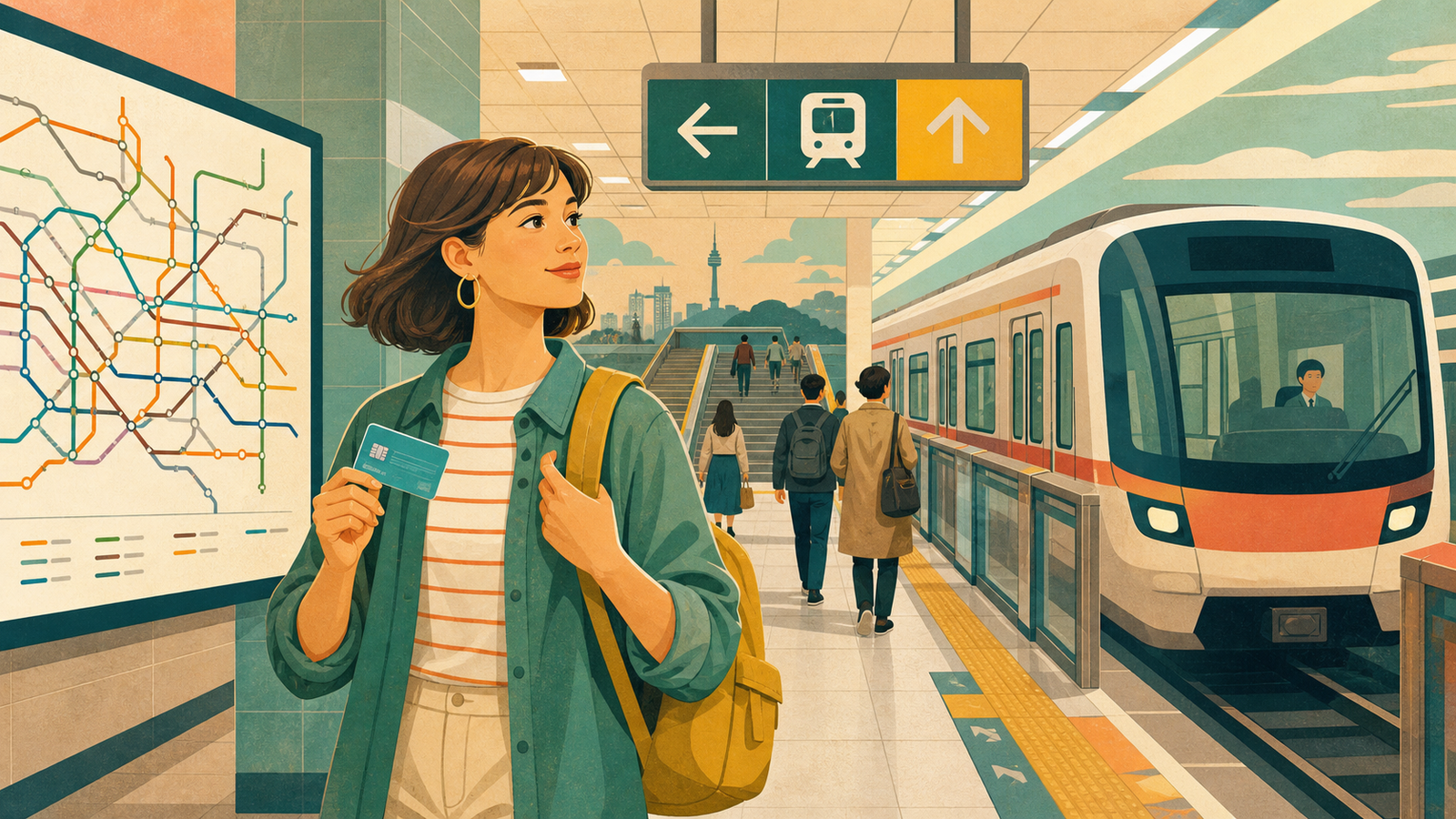
Seoul’s subway is usually the fastest and most predictable way to move around the capital. The network looks complicated at first, but every trip follows the same basic routine: choose the correct direction, tap in, follow the line color and station numbers, transfer inside the paid area, and tap out.
This guide explains the process from a visitor’s point of view, including current fare basics, single-journey tickets, transfers, platform signs, rush hour, last trains, luggage, and common mistakes.
Quick answer: what you need before your first ride
- A reloadable transportation card such as T-money, or a single-journey ticket
- A route-planning app that works well in Korea
- Your destination’s station name, line color, station number, and exit number
- Enough card balance for the full distance of the journey
If you will use public transportation more than once, a transportation card is usually easier than buying a ticket for every ride. Our complete T-money guide covers where to buy and reload one.
How much does the Seoul subway cost?
Seoul’s metropolitan subway uses a distance-based fare system. According to the Seoul Metropolitan Government’s official fare table, the adult base fare from June 28, 2025 is ₩1,550 with a transportation card and ₩1,650 for a single journey. Longer trips cost more, so the amount charged when you exit may be higher than the base fare.
Fare rules can change. Check the official Seoul transportation page linked in the sources below before relying on a specific price for a future trip. Children and registered youth cards use different fares, and some airport or privately operated sections may have separate pricing.
Transportation card or single-journey ticket?
Transportation card
For most visitors, a transportation card is the practical choice. Tap it on the gate reader when entering and leaving. It can also connect eligible subway and bus journeys under the integrated transfer system. Keep a modest extra balance so a longer ride does not leave you short at the exit gate.
Single-journey ticket
Multilingual ticket machines are available in subway stations. Select your destination, pay the fare and the refundable card deposit, then collect the single-journey card. Tap it at the entry and exit gates. After leaving, insert the card into a deposit-refund machine to recover the deposit. A single-journey card is for the subway and does not offer the same bus-transfer convenience as a reusable transportation card.
Step-by-step: taking your first subway ride
- Plan the route. Search by station rather than street address. Confirm the line color, station number, transfer station, and final train direction.
- Find the correct entrance. A station can have many street entrances. The entrance number is not the same as the platform direction.
- Tap in once. Place the card flat over the reader until the gate confirms the entry. Do not follow another passenger through the gate.
- Check the terminal-station direction. Platforms are usually labeled by the next major station or the end of the line. Compare the next station number with your route.
- Transfer without leaving the paid area. Follow the colored transfer signs and line number. Large stations can require a long walk.
- Tap out at the destination. The system calculates the final distance-based fare at the exit.
- Use the correct exit number. Choosing the right exit can save a long street-level walk or a difficult road crossing.
How transfers work
Transfers between subway lines normally happen inside the paid area. Follow signs for the new line rather than going through an exit gate. Station signs consistently use line colors, numbers, Korean names, and English names, but some transfer corridors are longer than they appear on a map.
The integrated fare system can also apply when transferring between eligible subway and bus services. You must use the same transportation card and tap correctly. The official Seoul guidance states that the transfer window is generally 30 minutes after leaving the previous service, extended to 60 minutes from 9 p.m. to 7 a.m. Transfer conditions and participating services matter, so do not assume every new ride is free.
Which app should you use?
Korean map and transit apps often provide better local routing than overseas map services. Check the final train direction, platform number when available, estimated travel time, number of stops, and recommended subway car for a faster transfer. See our guide to essential apps for maps, taxis, translation, and trains in Korea.
Last trains and operating hours
There is no single last-train time for the entire network. It varies by station, line, direction, weekday, weekend, and final destination. A late train may also stop before the end of the line. Check your specific route shortly before traveling and read the train’s destination display rather than assuming it continues to your intended stop.
For an important airport connection or a very late return, leave a generous buffer and identify a taxi or night-bus alternative in advance. If you are arriving through Incheon, compare the options in our Incheon Airport to Seoul guide.
Rush hour, luggage, and accessibility
Weekday trains are busiest during the morning and evening commute. If you have large luggage, avoid peak periods when possible, stand away from the doors while waiting, and let passengers exit before boarding. Elevators are available at many stations, but the accessible street entrance may be far from the exit closest to your destination. Search the station layout before traveling with a wheelchair, stroller, or heavy suitcase.
Keep bags close to your body, move toward the center of the carriage, and avoid blocking priority seats, doors, escalators, or transfer corridors. On escalators, follow posted station guidance rather than assuming the same standing convention everywhere.
Common mistakes and how to fix them
- You entered in the wrong direction: ask station staff before tapping out. Some stations allow a limited re-entry arrangement, but coverage differs.
- The gate will not open: try the card flat on the reader, then use the staffed gate or intercom. The card may have insufficient balance or an incomplete previous tap.
- You missed your stop: leave at the next station and follow signs to the opposite platform. Do not cross tracks or use restricted areas.
- You lost an item: note the line, direction, car number if visible, time, and stations. Contact station staff as soon as possible.
- You feel unsafe or unwell: contact station staff or use the emergency intercom. Save Korea’s key numbers with our emergency numbers guide.
A simple first-ride checklist
- Confirm the station, line, direction, and exit number.
- Keep enough balance on your transportation card.
- Tap at both entry and exit.
- Stay inside the paid area when changing subway lines.
- Check the exact last train for late-night travel.
- Allow extra time at large transfer stations.
Official sources and updates
- Seoul Metropolitan Government: Subway fares and transfer rules
- Seoul Metropolitan Government: Public transportation guide
- Seoul Metropolitan Government: Subway information for foreign visitors
Last reviewed: July 2026. Fares, transfer rules, and train schedules can change; verify time-sensitive details with the operator before travel.