
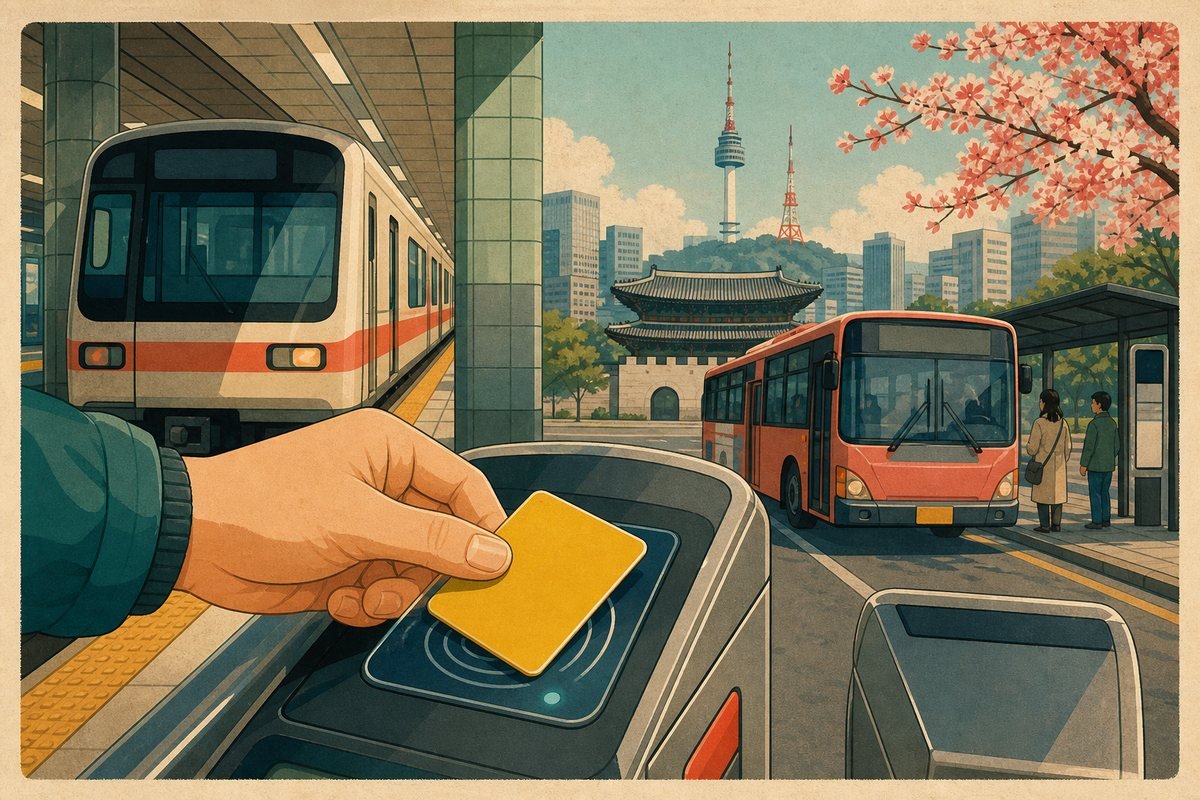
Updated July 2026. A T-money card is one of the simplest ways to pay for public transportation in Korea. You load money onto the card, tap it when entering and leaving, and the fare is deducted automatically.
This guide explains where to buy a T-money card, how to reload it, how to use it on buses and subways, and what first-time visitors commonly get wrong.
Quick answer
- Buy: Convenience stores displaying the T-money logo or sales locations in major subway stations.
- Load: Add a modest amount before your first trip. Cash is the most dependable option, although some newer station machines support additional payment methods.
- Subway: Tap once at the entrance gate and again at the exit gate.
- Bus: Tap when boarding and tap again before getting off.
- Transfers: Always tap out so the system can calculate the correct fare and any eligible transfer discount.
What is a T-money card?
T-money is a rechargeable prepaid transportation card. It is widely accepted on subways and city buses in Seoul and many other parts of Korea. It can also be used in participating taxis and at some affiliated stores.
You do not need a Korean bank account to use a physical prepaid card. The card itself and the stored balance are separate: buying an empty card does not mean it is ready for travel, so remember to add money.
Where to buy one
The easiest option is a convenience store such as CU, GS25, 7-Eleven, or emart24 that displays the T-money logo. Ask the cashier, “T-money card, please.” Designs and card prices vary, and special character or souvenir editions usually cost more.
In the Seoul metropolitan area, cards may also be available from subway-station vending machines or service locations. Availability differs by station, so a convenience store is often easier after a late arrival.
How much should you load?
For a short Seoul visit, start with a modest amount rather than loading a large balance. You can add more at convenience stores or station recharge machines. Transport fares and policies change, and the distance traveled affects some fares, so there is no single perfect amount for every traveler.
Keep some Korean won in small notes as a backup. Payment options at recharge locations can differ, and foreign cards are not guaranteed to work everywhere. If a machine offers English, select it before starting.
Using T-money on the subway
- Find the gate for your subway line and direction.
- Place the card flat on the reader until you hear a confirmation sound.
- Check the display: it normally shows the fare or remaining balance.
- At your destination, tap the same card at the exit gate.
If the gate does not open, do not force it or repeatedly tap different cards. Move aside and ask station staff for help. A low balance, an incomplete previous trip, or accidentally presenting two cards together can cause an error.
For platform directions, single-journey tickets, current Seoul fare basics, transfers, last trains, and station exits, continue with our first-time guide to using the Seoul subway.
Using T-money on a bus
- Board through the front door unless signs or staff direct otherwise.
- Tap the reader near the driver once.
- Press a stop button before your stop.
- Tap the reader near the exit door before getting off.
The final tap matters. It helps calculate distance-based fares and can preserve an eligible transfer discount. When traveling as a group, separate cards are the simplest choice because each passenger needs a complete tap-in and tap-out record.
Transfers: the important rule
Korea’s integrated transport system may apply transfer discounts between eligible buses and subways within a limited time. The exact rules depend on the city, route, time, and service. The practical rule is easy: use the same card throughout the journey and tap correctly every time you board and exit.
Checking your balance and reloading
Your balance appears briefly on many card readers after a tap. You can also ask a convenience-store cashier to check or reload it, or use a transportation-card machine in a subway station. Hand the cashier the card and the cash amount you want to add.
Can you get the remaining balance refunded?
Refund locations and limits depend on the remaining balance. A service fee may apply, and the original card purchase price is generally not refunded. Large-balance refunds can require a special service location, which is another reason to reload in smaller amounts.
Common mistakes to avoid
- Buying the card but forgetting to load money.
- Failing to tap when leaving a bus.
- Keeping several contactless cards together and triggering a card-reading error.
- Assuming every recharge machine accepts an overseas credit card.
- Loading a large amount shortly before leaving Korea.
- Using different cards when entering and exiting.
T-money or a Seoul Climate Card?
T-money is flexible and works well for occasional rides and travel beyond central Seoul. Seoul’s Climate Card offers unlimited use on covered services for a selected period, but coverage and purchase rules differ. Compare your itinerary before choosing; a pass is not automatically cheaper for every visitor.
Official information
Transport services, fares, and refund rules can change. Before traveling, check the Seoul Metropolitan Government public transportation guide, the official Seoul Climate Card guide, and the Korea Tourism Organization website.
Bottom line: buy a card, load a small amount, keep it separate from other contactless cards, and tap both when entering and leaving. That is enough to handle most subway and city-bus trips confidently.
Related transportation guides
- How to get from Incheon Airport to Seoul — compare the airport train, limousine bus, and taxi before arrival.
- How to take a taxi in Korea — learn about taxi apps, fares, payment, and safety.
- Essential apps for Korea — prepare maps, taxi, translation, and train tools.