
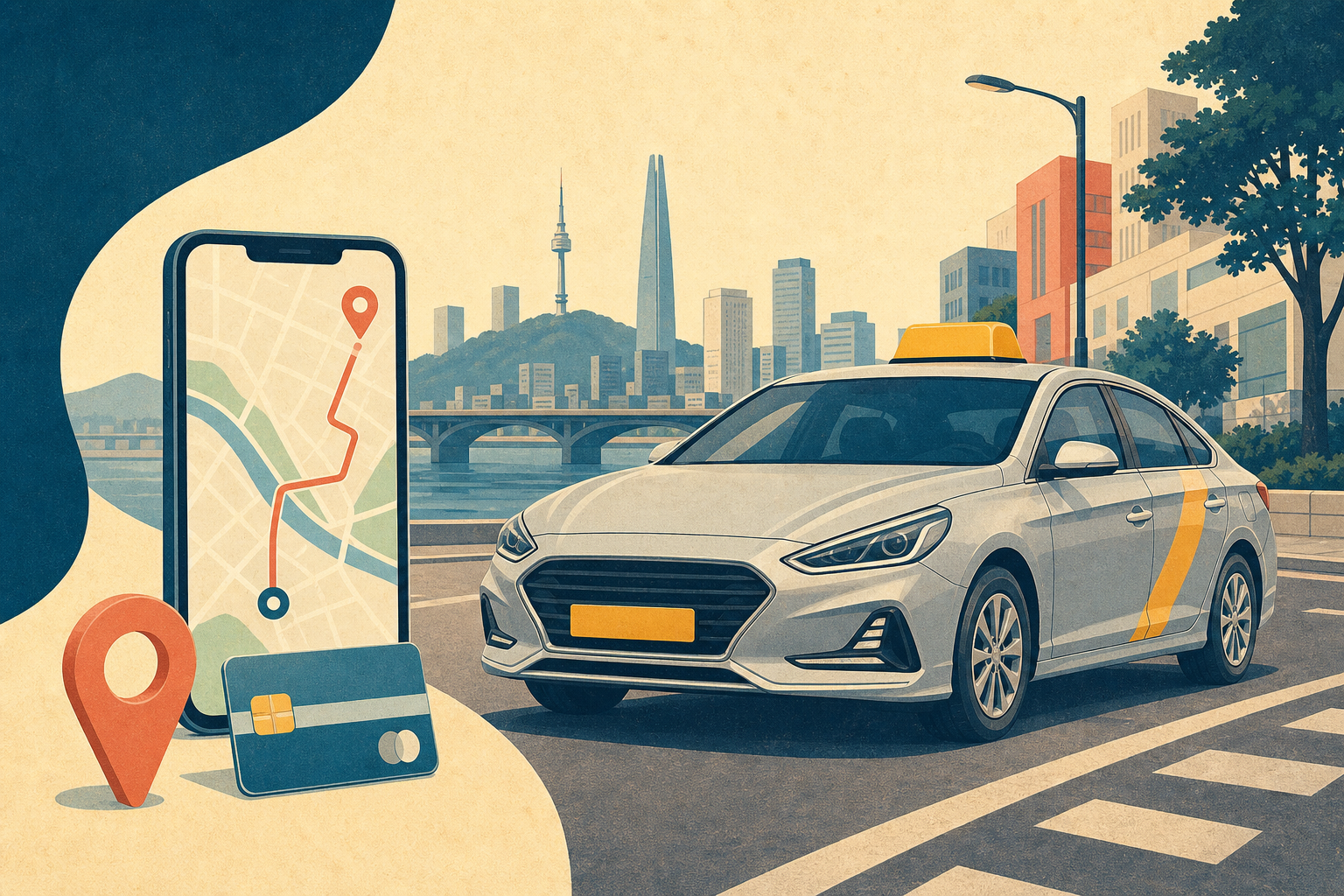
Taxis in Korea are clean, metered, and useful when the subway has stopped running, you have heavy luggage, or your destination is difficult to reach by public transport. The main challenge for international visitors is not the ride itself—it is choosing the right app, entering a destination correctly, and understanding how payment and late-night surcharges work.
This practical guide explains how to call or hail a taxi, which apps work with overseas accounts and cards, what a typical Seoul fare looks like, and how to avoid common mistakes. Fare examples below are based on official Seoul information available in July 2026; prices and rules can differ in other cities.
Quick answer: the easiest option for most visitors
Install k.ride or use Uber Taxi before you need a ride. Enter the exact destination, check the vehicle plate number after a driver accepts, and confirm whether payment will be made in the app or directly to the driver. Keep a physical card and some Korean won as backup.
- Best for a foreign visitor: k.ride, which supports English, Japanese, Simplified Chinese, and Traditional Chinese and accepts overseas card registration.
- Best if you already use Uber: Uber Taxi, which can use your existing account and saved payment method.
- Best for residents with a Kakao account: Kakao T, Korea’s most widely used local taxi platform.
- Without an app: use a marked taxi stand or hail an available taxi on a safe roadside.
Which taxi app should you use in Korea?
k.ride
k.ride is operated by Kakao Mobility for international travelers. It uses Kakao’s taxi network but offers a simpler sign-up process for non-residents. You can sign in with Google or Apple, search for destinations in a supported language, register an international credit card, see an estimated fare, and use translated messaging with the driver.
For a short-term visitor, this is usually the most straightforward choice. Download and set it up while you still have reliable Wi-Fi. Add a payment card and test destination search before leaving the airport or hotel.
Uber Taxi
Uber in Korea generally connects passengers with licensed local taxis. If you already have the Uber app and a working payment method, you can continue using the familiar interface. The official Korea tourism site also notes that the app provides automatic message translation.
Availability can vary by location and time. In a busy entertainment district late at night, compare the estimated wait time with another app instead of repeatedly cancelling requests.
Kakao T
Kakao T offers broad coverage throughout Korea, including Jeju Island, but its local account and payment setup can be less convenient for a short-term visitor. The app can still be useful if you already have a Kakao account. Depending on the ride option, you may be able to select direct payment to the driver rather than app payment.
Do not install several unfamiliar apps at the roadside. Set up one primary app and one backup before your trip, then save your hotel and major destinations.
How to call a taxi step by step
- Enter the destination, not just the neighborhood. Use the building name, street address, hotel, station exit, or map pin. Large districts can cover a wide area.
- Check the pickup pin. Move it to the correct side of a divided road when possible. A driver may not be able to make an immediate U-turn.
- Choose the vehicle type carefully. Standard taxis are normally sufficient for one to three travelers with ordinary luggage. Choose a larger vehicle if your group has several large suitcases.
- Review the estimate and payment method. An estimate is not always a fixed price. Traffic, waiting time, tolls, late-night surcharges, and some app service types can change the final total.
- Match the plate number. After a driver accepts, compare the plate number and vehicle information in the app before getting in.
- Confirm the destination. Show the app screen or the address written in Korean if necessary. Avoid relying only on an English place name.
- Check the payment result. If the app charged you automatically, do not pay the driver a second time. If you selected direct payment, use a card or cash at the end of the ride.
How much do taxis cost in Seoul?
According to the Seoul Metropolitan Government’s current taxi guide, a standard sedan taxi has a daytime base fare of ₩4,800 for the first 1.6 km. After that, the meter adds distance and time charges. Slow traffic can raise the fare because time is included when the taxi is moving below the stated speed threshold.
Late-night pricing is higher:
- 10:00 p.m.–11:00 p.m.: 20% late-night surcharge
- 11:00 p.m.–2:00 a.m.: 40% late-night surcharge
- 2:00 a.m.–4:00 a.m.: 20% late-night surcharge
Trips beyond Seoul’s city boundary can also receive an outside-city surcharge. A late-night ride that also leaves the city can therefore cost considerably more than the daytime estimate. Expressway tolls are normally added when the route uses a toll road.
Other cities set their own fares, and premium, large, or app-branded vehicles may use different rate systems. Treat Seoul figures as a planning reference rather than a nationwide price guarantee.
Can you pay by foreign credit card?
Most ordinary taxis in major cities accept Korean credit cards, and many card terminals also process international Visa or Mastercard payments. Acceptance is not perfect, so carry a backup. A physical card with chip support is more reliable than depending only on a phone wallet.
With k.ride or Uber Taxi, an eligible overseas card can be charged in the app. Check the payment screen before requesting the car. If the app displays direct payment to the driver, the app is arranging the ride but not collecting the fare.
Cash remains useful when a foreign card is declined. Ask for a receipt if you need to track expenses or recover a lost item. For broader preparation, read our guide to using foreign credit cards in Korea and our foreign-card ATM guide.
Airport taxi tips
At Incheon Airport, follow signs to the official taxi stands outside the terminal and ignore unsolicited ride offers inside the arrivals area. Standard metered taxis, large taxis, and international taxis have different fares and service features.
Before choosing a taxi, compare the expected price and travel time with the AREX train or airport limousine bus. A taxi is especially practical late at night, for groups splitting the fare, or when carrying heavy luggage. Tolls and airport-to-city fare arrangements can affect the total. See our full Incheon Airport to Seoul comparison before deciding.
Street hailing and taxi signs
You can still hail a taxi without an app. Stand where the driver can stop safely, raise one hand, and have your destination ready in Korean. Taxi roof lights and dashboard signs indicate availability, but colors and displays vary, so an app is easier for first-time visitors.
Do not wait at a bus stop, in an intersection, or on a road where stopping is prohibited. Near large stations and hotels, use the marked taxi queue. At night, a nearby side street may be easier for pickup than the entrance of a crowded club or festival venue.
Safety and troubleshooting
- Verify the plate: never enter a car that does not match the app.
- Keep the trip record: the app receipt, plate number, and pickup time help if an item is lost.
- Follow the meter: ordinary taxis should use the approved meter unless you selected a service with a stated fixed or flexible app fare.
- Use the map: traffic restrictions may create a route that looks indirect, but you can still monitor the trip calmly.
- Call for help when necessary: dial 112 for police or 119 for fire and medical emergencies. The 1330 Korea Travel Helpline can assist travelers with tourism information and interpretation.
If a driver cannot find you, send a short translated message with a landmark, station exit number, or convenience-store name. If the app repeatedly fails, walk to a legal pickup point on a less congested street and try again.
Useful Korean phrases
- 여기로 가 주세요 (Yeogiro ga juseyo): Please go here.
- 이 주소로 가 주세요 (I jusoro ga juseyo): Please go to this address.
- 카드 돼요? (Kadeu dwaeyo?): Can I pay by card?
- 여기서 세워 주세요 (Yeogiseo sewo juseyo): Please stop here.
- 영수증 주세요 (Yeongsujeung juseyo): Please give me a receipt.
Before your first ride
Save your accommodation in both English and Korean, take a screenshot of the address, and keep your phone charged. Make sure mobile data works away from Wi-Fi; our Korea SIM and eSIM guide can help. For most visitors, one multilingual taxi app, one backup payment method, and the exact Korean address are all you need.
Official sources
- Seoul Metropolitan Government: Taxi Usage Guide and fares
- VISITKOREA: Taxi information
- VISITKOREA: Ride-hailing apps in Korea
- k.ride official English page
Last reviewed: July 2026. Fares, app features, and payment support can change. Confirm the estimate and payment method shown in your app before requesting a ride.