
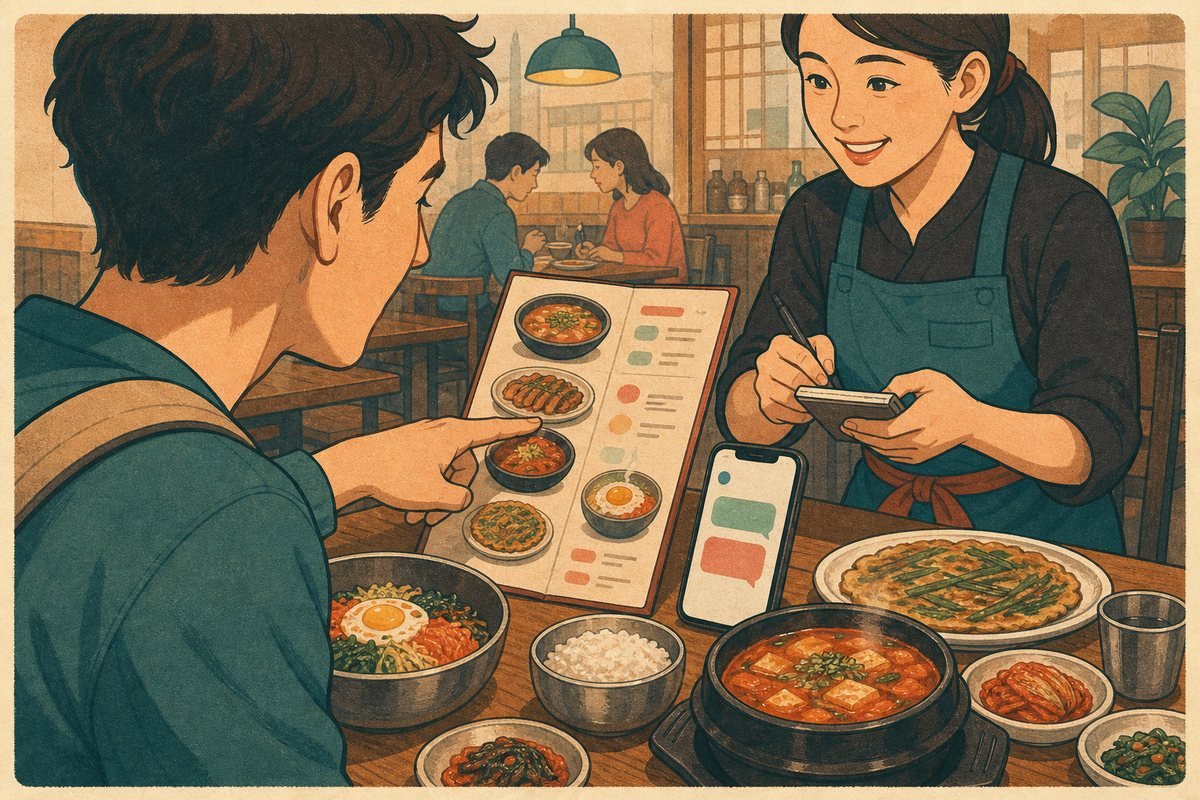
Updated July 2026. You can eat well in Korea without speaking Korean. Many restaurants use photos, tablets, kiosks, call buttons, or menus with some English, and staff are generally used to helping visitors.
The most useful preparation is not memorizing a long phrasebook. Save the Korean name of the dish you want, install a translation app, and understand how ordering, side dishes, water, payment, and table service usually work.
Quick ordering method
- Find the restaurant and menu in NAVER Map or another local listing.
- Save a screenshot of the Korean dish name.
- Check whether you order with staff, a kiosk, a tablet, or a QR code.
- Point to the item and show the quantity with your fingers.
- Confirm the total before paying.
Useful Korean phrases
- 이거 주세요 (igeo juseyo): This one, please.
- 두 개 주세요 (du gae juseyo): Two, please.
- 여기요 (yeogiyo): Excuse me / Please come here.
- 물 주세요 (mul juseyo): Water, please.
- 안 매운 거 있어요? (an maeun geo isseoyo?): Do you have something not spicy?
- 포장해 주세요 (pojanghae juseyo): Please pack it to go.
- 계산할게요 (gyesanhalkkeyo): I’d like to pay.
- 감사합니다 (gamsahamnida): Thank you.
Pronunciation does not need to be perfect. Showing the written Korean text is often clearer in a noisy restaurant.
How ordering works
Ordering from staff
Some restaurants take the order at the table. Raise your hand, press the call button, or say “yeogiyo.” Point to the menu item and state the quantity. At busy restaurants, staff may expect the whole order at once.
Ordering at a kiosk
Fast-food restaurants, cafés, food courts, and casual chains often use self-order kiosks. Look for an English or language button before starting. Choose dine-in or takeout, select the items, review options, and pay.
Some kiosks accept foreign cards, while others work only with certain Korean payments. If payment fails, ask staff to order at the counter or use another card.
Tablet or QR ordering
Barbecue restaurants, pubs, and newer restaurants may have a tablet at the table. A language setting may be hidden in a corner of the screen. QR menus can require mobile data, so keep a translation app ready.
Understanding Korean menus
Prices may be listed per person, per serving, per 100 grams, or per set. At barbecue restaurants, the menu may require a minimum first order of two servings even when one person could physically finish less.
- 1인분 (il-inbun): one serving or portion
- 2인 이상 (i-in isang): two or more people / minimum for two
- 세트 (seteu): set or combo
- 추가 (chuga): extra / add-on
- 포장 (pojang): takeout
- 매운맛 (maeunmat): spicy flavor
Use image translation for unfamiliar text, but verify the price and quantity separately. Machine translation sometimes confuses a whole dish with an optional extra.
Side dishes and water
Korean meals often include small side dishes called banchan. Kimchi, pickles, vegetables, or sauces may arrive without being ordered. Basic refills are often free at ordinary restaurants, although special or premium sides can cost extra.
Many restaurants are self-service. Look for a water dispenser, cups, utensils, napkins, or a side-dish refill station. Spoons and chopsticks may be inside a drawer under the edge of the table.
Korean barbecue basics
- Check the minimum number of meat portions before sitting down.
- Staff may grill the meat or expect guests to do it.
- Do not start moving the meat if staff are actively cooking it.
- Use the provided tongs and scissors for raw meat.
- Wrap cooked meat in lettuce or perilla leaves with sauce and side dishes.
- Order rice, stew, or fried rice separately if it is not included.
If you are unsure, watch nearby tables or ask “How?” while pointing to the grill. Staff will usually demonstrate.
Spice levels are difficult to predict
A red dish is not always extremely spicy, and a pale-looking soup can still contain chili. “Not spicy” may mean the restaurant cannot remove a sauce that was prepared earlier.
- 맵지 않게 해 주세요 (maepji anke hae juseyo): Please make it not spicy.
- 고추 빼 주세요 (gochu ppae juseyo): Please leave out the chili peppers.
- 소스 따로 주세요 (soseu ttaro juseyo): Please put the sauce on the side.
These requests are not always possible. Ask before ordering rather than after the dish arrives.
Allergies and dietary restrictions
Do not assume a dish is vegetarian, vegan, halal, gluten-free, or allergen-free based only on its visible ingredients. Broth, sauces, kimchi, noodles, dumplings, and side dishes can contain seafood, meat stock, fish sauce, soy, wheat, sesame, egg, nuts, or pork-derived ingredients.
For a serious allergy, carry a professionally translated allergy card that lists the exact ingredient and explains cross-contact risk. Translation apps are helpful but should not be the only safety measure. If staff cannot confidently confirm, choose another restaurant or packaged food with a readable label.
Reservations and waitlists
Popular restaurants may use a reservation or digital waitlist system. Some Korean platforms require a local phone number or payment method. CATCHTABLE GLOBAL is designed for international users and can support reservations or waitlists without a Korean phone number at participating restaurants.
Always check the cancellation policy, deposit, arrival time, and number of guests. A reservation for two people may not be accepted for a solo diner during busy hours.
Paying and tipping
Payment is commonly made at a counter near the entrance rather than at the table. Bring the table number or receipt if one was provided. Major foreign cards work at many established restaurants, but keep Korean won for street stalls and small markets.
Tipping is not customary at ordinary Korean restaurants. Pay the amount shown on the bill unless a clearly disclosed service charge applies.
Common mistakes to avoid
- Assuming every side dish or refill is free.
- Ordering one portion where the menu requires two.
- Ignoring a self-service sign and waiting indefinitely for staff.
- Leaving without paying because you expected the bill at the table.
- Sticking chopsticks upright in a bowl of rice.
- Relying on a visual guess for allergies or dietary restrictions.
- Expecting every restaurant to provide takeout containers.
Official sources
Restaurant systems and visitor services change. See the Korea Tourism Organization guide to Korean food and restaurants, the Official Seoul etiquette guide, and the VISITKOREA guide to CATCHTABLE GLOBAL.
Bottom line: save the Korean dish name, point and confirm the quantity, check for self-service, pay at the counter, and communicate serious dietary needs with a clear translated card.