
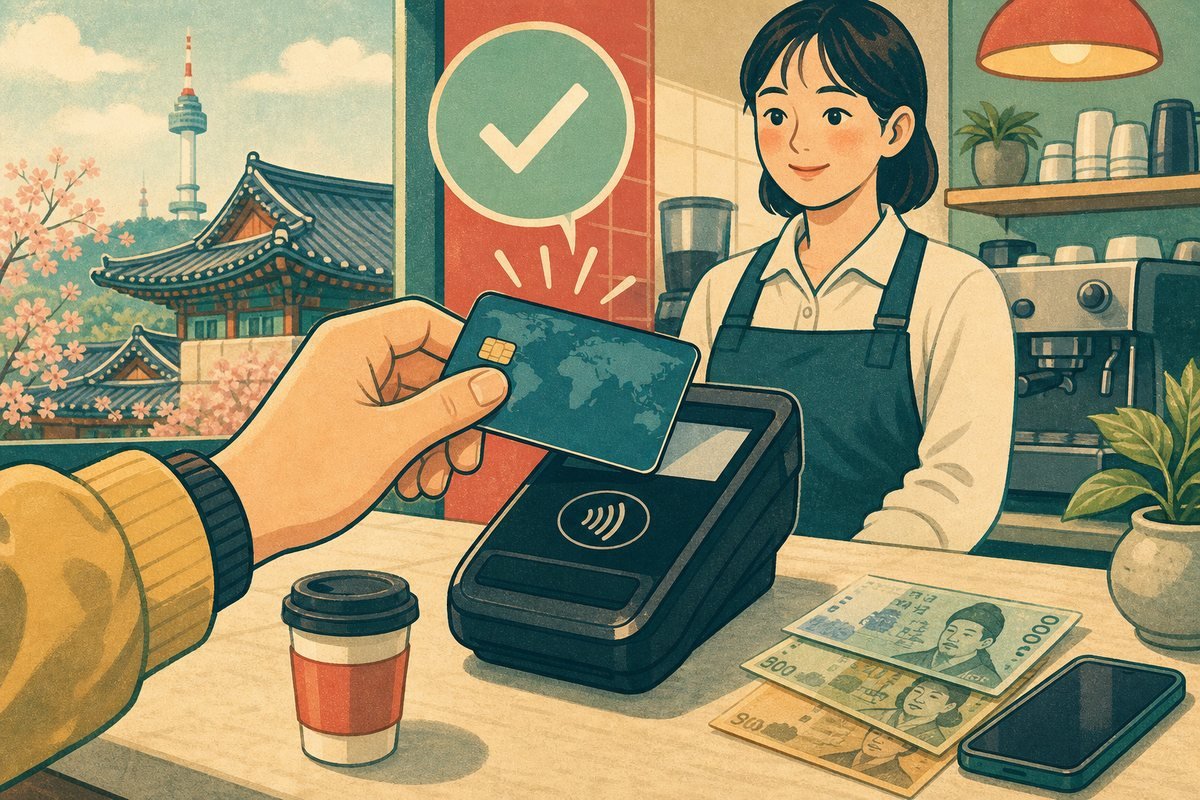
Updated July 2026. Foreign-issued credit and debit cards work at most hotels, department stores, restaurants, cafés, convenience stores, and tourist attractions in Korea. Visa and Mastercard generally have the broadest acceptance, while American Express, JCB, and UnionPay availability varies by merchant.
Still, a card-only trip can become inconvenient. Small market stalls, older machines, transportation-card reloads, and some online services may require cash or a Korean-issued payment method.
Quick answer
- Bring at least two cards from different networks or issuers.
- Keep a modest amount of Korean won for backup.
- When offered a currency choice, compare carefully and normally choose Korean won (KRW).
- Do not assume your foreign card can tap directly at every subway or bus gate.
- Tell your bank about travel plans if its security system requires it.
Where foreign cards usually work
Card payment is common throughout Korea, including for small purchases. Most chain businesses, shopping malls, supermarkets, hotels, museums, and established restaurants accept major international cards.
- Hotels and guesthouses with staffed reception
- Department stores and major shopping centers
- Convenience stores and supermarkets
- Chain cafés and restaurants
- Pharmacies, clinics, and hospitals
- Taxi card terminals
- Major attractions and ticket offices
Acceptance never guarantees approval. Your bank can block an overseas transaction, the merchant terminal may not recognize a particular card, or a temporary network problem may occur.
Where you may still need cash
- Traditional market stalls and street-food vendors
- Small rural businesses or temporary festival booths
- Coin lockers, laundromats, or older vending machines
- Adding value to a standard T-money card at many convenience stores and machines
- Small deposits, local services, or situations where a terminal is offline
Payment infrastructure is changing. Seoul introduced new subway machines in 2026 that accept internationally issued cards for certain single-journey tickets and short-term Climate Card purchases or reloads. This does not mean every machine or ordinary T-money reload point accepts foreign cards.
Can you tap a foreign card on buses and subways?
Do not rely on an ordinary foreign contactless bank card to open every Korean transit gate. Most travelers should use T-money, another compatible transportation card, an eligible transit pass, or a single-journey ticket.
A station machine accepting your credit card to buy a ticket is different from the gate accepting that credit card as the travel credential. Buy the correct ticket or transit card first, then tap that item at the gate.
Choose Korean won at the terminal
A card terminal or ATM may offer to convert the transaction into your home currency. This is called Dynamic Currency Conversion, or DCC. The displayed home-currency amount may feel convenient, but its exchange rate can include an additional markup or fee.
You have the right to accept or decline the conversion. In most ordinary situations, choosing the local currency—Korean won (KRW)—allows your card network and bank to perform the conversion under their own terms. Compare your card’s foreign-transaction fee before deciding.
- Look for KRW or the ₩ symbol.
- Do not let a merchant choose the currency without asking you.
- Read the amount before entering a PIN or signing.
- Keep the receipt if the wrong currency was used.
Why a foreign card may be declined
- Issuer security: the bank sees an unexpected overseas transaction.
- Online verification: a Korean website requires local identity or a Korean-issued card.
- Offline terminal: the merchant’s device cannot contact the network.
- Card settings: international, contactless, online, or cash-withdrawal functions are disabled.
- Network support: the merchant does not accept your card brand.
- PIN issue: an ATM or unattended terminal requires a compatible PIN.
What to do when payment fails
- Ask the merchant to try the physical chip instead of contactless payment.
- Try your second card from another issuer or network.
- Check your banking app for a fraud alert or approval request.
- Use Korean won cash if the purchase is urgent.
- Contact the card issuer using the number in the app or on the back of the card.
- Do not repeat the same transaction many times if the amount appears pending.
Using Korean ATMs
Look for an ATM labeled “Global” or displaying your card network. Airports, major banks, convenience stores, and busy subway areas often have machines that support foreign cards and English instructions.
The ATM operator and your home bank may both charge fees. The withdrawal limit may be lower than your bank’s normal limit. If the ATM offers conversion into your home currency, review the exchange rate and markup before accepting.
Mobile wallets and contactless payment
Contactless acceptance is increasing, but it is not universal. A merchant that accepts the physical version of your card may not support the same card through Apple Pay, Google Wallet, or another mobile wallet.
Carry the physical card and know its PIN. Do not make your phone wallet the only payment method, especially if your battery, data connection, or device security could prevent access.
Should you get a visitor prepaid card?
Visitor-focused prepaid products such as WOWPASS or Trip.PASS can be useful for budgeting, payment, currency exchange, or combined travel features. They are optional rather than necessary for most visitors with a reliable international card.
Compare issuance fees, top-up methods, exchange rates, refund rules, accepted merchants, and whether the transportation balance is separate from the payment balance. Do not buy a prepaid card only because a social-media post calls it essential.
Before you travel
- Check international purchase and ATM fees.
- Enable overseas transactions if required.
- Set a PIN you know and test the card before departure.
- Save the issuer’s support number separately from the physical card.
- Bring two cards and store them separately.
- Carry enough cash for transportation and one day of basic expenses.
- Turn on transaction notifications.
Official sources
Payment and transit systems continue to change. Check the Seoul Metropolitan Government currency and payment guide, the Korea Tourism Organization currency guide, the 2026 Seoul transit payment update, and Visa’s DCC explanation.
Bottom line: foreign cards work for most everyday purchases in Korea, but bring two cards, keep some won, use a separate transit card, and carefully choose KRW when a terminal offers currency conversion.